
English| EUR
Suggested for you
More currencies
Choose a language
Few questions about Yosemite National Park get answered as loosely online as this one, and the loose answers cost travellers whole afternoons. No rail line has ever been laid into Yosemite Valley itself, yet a car-free journey from the Bay Area remains entirely workable. This page sets out what the railway does and does not do, and where the handover to road transport occurs.
Quick answer
No — there is no direct train into Yosemite National Park; the nearest rail service ends outside the boundary, and the final leg is by connecting bus. Amtrak's San Joaquins line reaches Merced, where scheduled coaches continue into Yosemite Valley. The park itself admits visitors around the clock, 00:00–23:59 daily, so late arrivals are not locked out — but connecting coach schedules are finite.
Yosemite is one of the very few American parks of its stature that a railway never conquered. The Yosemite Valley Railroad ran from Merced towards El Portal between 1907 and 1945, carrying visitors to within a short stage-ride of the Valley floor, and then it closed for good. Its roadbed lies under Highway 140 in places. That closure is the single historical fact that shapes every modern itinerary, and it is why the question is there a train from san francisco to yosemite has no tidy yes attached to it. What survives is a rail spine that stops short of the granite. The practical picture is a relay, not a ride. Rail service from the Bay Area runs through the Central Valley to Merced, which functions as the interchange town rather than a destination; from there, road transport covers the remaining miles through the Merced River canyon and past the Arch Rock entrance into Yosemite Valley. Travellers researching Yosemite public transport options will find the same architecture behind every car-free plan: a long rail or coach segment across flat farmland, then a mountain leg on a two-lane highway that no timetable can hurry. Half Dome, El Capitan and Yosemite Falls all sit within a few miles of the Valley shuttle loop once that final leg is complete, which is the reason the relay is worth assembling at all. What this means for planning is a matter of margins. A San Francisco to Yosemite rail and coach journey is governed by the least frequent link in the chain, and the mountain leg is always that link. Missing one connection in Merced does not shift a departure by twenty minutes; it can shift the arrival into the Valley by half a day. Anyone weighing the San Francisco Yosemite day trip against an overnight stay should test the itinerary against the return leg first, because the last outbound coach of the day sets the real shape of the visit. A reader who arrives at this page asking is there a train from san francisco to yosemite usually wants permission to leave the car behind. That permission exists — with the caveat that the Valley is reached in stages, that Merced is the hinge, and that the schedule, not the distance, is the constraint. The route sections that follow lay out each leg, the alternatives, and the timings in detail.
“The railway stops short of the granite; the last miles have always belonged to the road.”
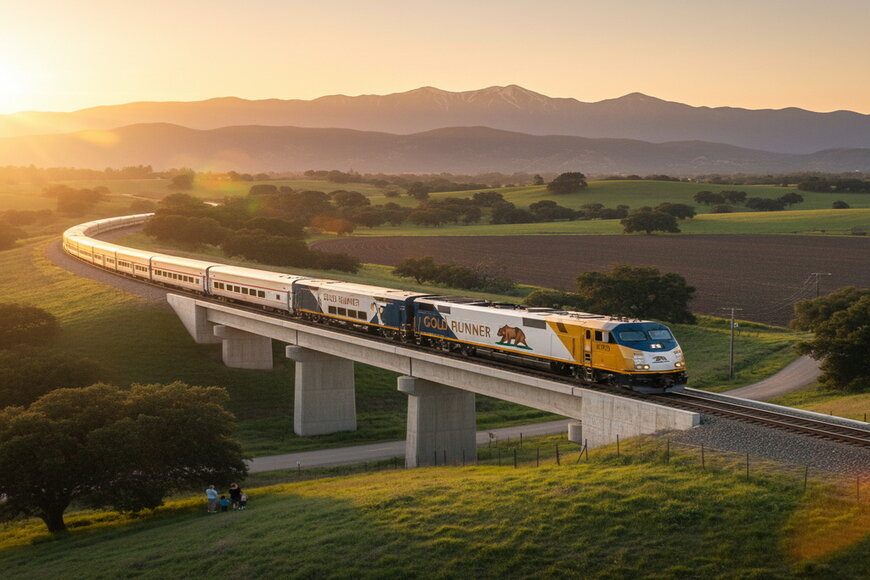
Yosemite National Park is in the Sierra Nevada east of the San Joaquin Valley, so there is no train station inside the park. The practical rail option is to take Amtrak San Joaquins to Merced and connect to YARTS for the ride into Yosemite Valley.
Amtrak San Joaquins to Merced (MCD)
YARTS Highway 140 from Merced Amtrak to Yosemite Valley Lodge or Yosemite Village
YARTS Highway 120 from the Central Valley to Yosemite Village
YARTS Highway 41 from Fresno or Madera to Yosemite Village
If you are using public transit, aim for the Merced Amtrak station and then continue on the YARTS Highway 140 route, which is the clearest rail-plus-bus link into Yosemite Valley. For driving arrivals, use the South Entrance if you are coming from the Merced and Mariposa side; parking fills early, so a morning arrival is the least stressful.
There is no direct train from San Francisco to Yosemite National Park. The practical choice is a rail-and-bus connection through Merced, or a bus-only connection if you want fewer rail steps.
| Amtrak + YARTS Rail to Merced, then YARTS into the park Recommended | Greyhound + YARTS Bus to Merced, then YARTS into Yosemite Valley | Airport-based transit Fly into Merced or Fresno, then connect by YARTS or local transit | |
|---|---|---|---|
| Route path | San Francisco rail service to Merced, then Amtrak Connection bus Route 15 to Yosemite Valley | San Francisco bus service to Merced, then YARTS Highway 140 into Yosemite Valley | San Francisco flight to Merced or Fresno, then YARTS Highway 140 or Highway 41 into Yosemite Valley |
| Transfer points | Merced Station (MCD) and Yosemite Valley handoff | Merced bus stop and Yosemite Valley handoff | Merced Regional Airport or Fresno Yosemite International Airport, then a ground-transfer stop |
| Typical service area | Amtrak San Joaquins corridor and Yosemite Valley via Merced | Central Valley bus corridor and Yosemite Valley via Merced | Airports in the Central Valley with onward park service |
| Who operates it | Amtrak and YARTS | Greyhound and YARTS | Airlines plus YARTS or local airport ground transport |
| Best fit | Travelers who want a rail trip with one bus transfer into the park | Travelers who want a bus-first option with one park shuttle transfer | Travelers who prefer air travel and then a ground connection into Yosemite |
Verdict: Pick Amtrak + YARTS if you want the cleanest rail-and-bus connection, Greyhound + YARTS if you are starting with intercity bus travel, and airport-based transit if your trip begins with a flight rather than a train.
The best time to use public transit to Yosemite is summer, when bus connections are broadest and more areas are reachable. For the smoothest park arrival, aim for the early-morning window from 00:00–09:00, which usually means fewer crowds and easier parking or transfer timing.
Warm; Yosemite Valley can reach 100°F
This is the easiest season for transit-based trips because service is most extensive and more park areas stay open. If you are connecting from San Francisco, build in extra time for transfers and same-day movement inside the park.
Mild days; cooler nights
These months can work well if you want lighter congestion, but some higher-elevation roads and services may still be limited. Check conditions before you go, especially if your plans depend on reaching beyond Yosemite Valley.
Snow, chains may be required
Winter is the least complicated for crowd levels but the most restrictive for transit flexibility. Expect seasonal road and service limits, and plan around the parts of the park that remain open.
—
Arriving early on a weekday gives you the best chance at a calmer entry experience and simpler connections. The 00:00–09:00 arrival window is the most reliable choice for a smoother start.
—
These periods tend to create the most delay at park access points and on connecting buses. If your trip falls on a holiday weekend, start as early as possible and allow extra buffer time.
Verdict: For the simplest transit trip, go Tuesday to Thursday in April or October and arrive between 00:00 and 09:00.
Yosemite National Park is open year-round, and the park’s published hours run continuously every day of the week. Plan around the fact that some access points can still be limited by daylight or snow conditions.
No seasonal hour changes are listed in the published hours. Some roads or access points may be limited by daylight or snow-related conditions, so verify official updates before arrival.
Admission costs hinge on how you enter and whether you are a non-U.S. resident. Yosemite’s official standard entrance pass and the separate nonresident fee are charged by the park; rail and bus fares are set by the carrier.
Verdict: A typical adult pays the park’s standard entrance pass, while the main factor that changes the total is whether the visitor is a non-U.S. resident age 16 or older, which adds the separate $100 USD fee.
Train travel to Yosemite usually involves a rail ride to Merced and a timed bus transfer, so the key is confirming where your last segment ends before you book.
Amtrak’s Yosemite service requires a change to a connecting bus after the rail leg, and that bus is what gets you into Yosemite Valley. Build extra buffer time into your day in case the train arrives late or the connection is tight.
Some services stop at a gateway city or Yosemite Valley lodge area rather than every point inside the park, so verify the exact endpoint on your itinerary. If you need Yosemite Valley specifically, do not assume any Yosemite-branded ticket goes there.
YARTS notes that luggage storage is not available in Yosemite, so carry only what you can manage on and off the bus. Soft bags are easier than rigid suitcases when you’re making a rail-to-bus transfer.
An early departure helps because the rail segment and the connecting bus both run on fixed schedules, and missing one leg can push your arrival much later. It also leaves more daylight for the mountain roads and any shuttle connections.
When possible, book the rail and bus as one through itinerary so the connection is coordinated. Separate tickets can leave you responsible for rebooking if a delay breaks the transfer.
Some Yosemite-area public transit runs only in summer or on limited dates, especially routes that go beyond Yosemite Valley. Recheck the operator’s current timetable before you count on a specific branch of service.
Yosemite Valley’s shuttle system is fully accessible, with wheelchair lifts and tie-downs on the buses. Assistance is available from drivers, and accessible information is published by the park for visitors who need more detail.
All shuttles are accessible with wheelchair lifts and tie-downs.
Designated shuttle stops allow boarding and disembarking without stairs.
Wheelchair lifts are available on the shuttle buses.
Some shuttle stops have restrooms, but availability varies by stop.
Park accessibility materials and Deaf Services support are available through Yosemite.
No quiet-time program is listed for shuttle accessibility.
Reaching Yosemite by rail takes several connecting legs, so settle these details before you leave San Francisco.
Everything you need to know about is there a train from san francisco to yosemite
No direct train goes from San Francisco to Yosemite National Park. The usual rail plan is to ride Amtrak's San Joaquins to Merced, then transfer to the YARTS bus for Yosemite Valley.
The most common rail-and-bus route is San Francisco Bay Area to Merced on Amtrak, then a Yosemite-bound YARTS connection. Amtrak lists a Merced-to-Yosemite National Park thruway link, and YARTS serves Yosemite Valley stops.
Travel time varies by departure, but the rail leg to Merced is a several-hour ride, and the onward YARTS transfer adds more time. For example, Amtrak's San Joaquins timetable shows Merced departures around 9:23 a.m. and 7:34 p.m. on one daily schedule, with Yosemite thruway buses continuing from Merced.
Booking ahead is a smart move, especially in summer, because YARTS notes reservations are available in limited quantities. Walk-ons are accepted when space permits, so the trip can fill up on busy days.
Yosemite's standard entrance fee is $20 to $35, and non-U.S. residents ages 16 and older pay an additional $100 per person. Yosemite also states that no reservation is required to enter in 2026, though the entrance fee still applies.
No, there is not a direct train from San Francisco to Yosemite Valley. Amtrak directs riders to Merced for the Yosemite connection, and the last leg is by bus rather than rail.
For Yosemite access by train, Merced is the key transfer point. Amtrak's Yosemite service pages and timetable show the Merced connection, while YARTS operates the bus into Yosemite National Park.
Yes, families can use the rail-and-bus route, and YARTS has child fare rules that can reduce cost for younger riders. One child age 6 to 12 rides free with each paid adult fare, and children 5 and under ride free.
Yosemite and Giant Sequoias Day Trip from San Francisco
Read more GuideThe Ultimate Yosemite Day Trip from San Francisco Itinerary
Read more GuideIs a Yosemite Day Trip from San Francisco Worth It?
Read more GuideDistance from San Francisco to Yosemite by Car
Read more Tickets & toursYosemite 2-Day Trips from San Francisco
Read more